
What Is the O Level English Oral Examination?
Paper 4: Oral Communication is the speaking component of the GCE O Level English Language examination. It assesses how clearly and effectively you express ideas, respond to questions and engage in spoken discussion.
Paper 4 takes place in July, in the second half of the year, and the written papers follow a few months later. The examination lasts about 20 minutes per candidate, including about 10 minutes of preparation time. Two examiners are usually present, with one leading the discussion while the other assesses and records your performance.
In this guide, we explain the O Level Oral exam format and marking criteria, look at common question types and share practical strategies to help you prepare effectively.
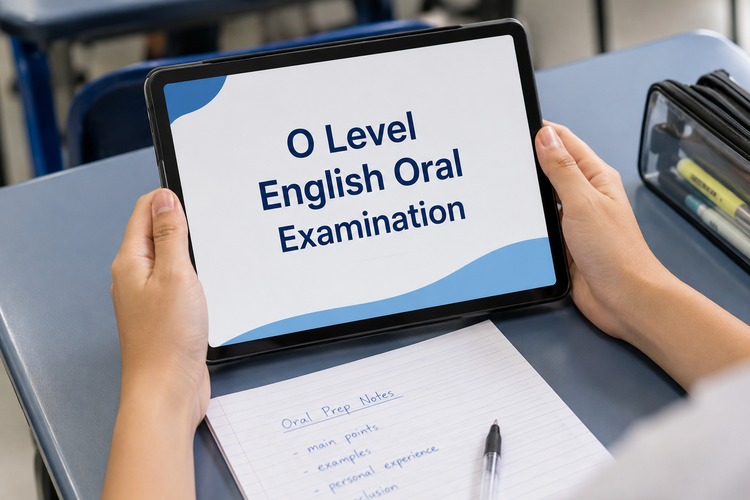
O Level Oral Exam Format and Marking
The O Level Oral examination has two components, Planned Response and Spoken Interaction, both based on the same short video clip and assessed together for a total of 30 marks.
| Component | Format | Time | Marks |
|---|---|---|---|
| Preparation | Watch the video clip and prepare notes | Approx. 10 minutes | — |
| Planned Response | Deliver a prepared spoken response to a set question on the video | Up to 2 minutes | 15 |
| Spoken Interaction | Discuss a related topic with the examiners | Approx. 5 minutes | 15 |
- For Planned Response, examiners assess both your Response and Delivery. Response (10 marks) covers how well you develop, organise, and express your ideas. Delivery (5 marks) assesses your pronunciation, fluency, and intonation.
- For Spoken Interaction, you are assessed on how clearly you communicate your perspectives and how effectively you engage in discussion with the examiners (15 marks).
What the O Level Oral Exam Assesses
The O Level Oral examination assesses how clearly, fluently, and thoughtfully you communicate your ideas in both prepared speaking and discussion.
- Development and organisation of ideas — How logically you structure and connect your points.
- Expression of ideas — Your range and accuracy of vocabulary and sentence structures.
- Pronunciation, fluency, and intonation — How clearly and naturally you speak, including your pacing and tone.
- Communication of perspectives — In Spoken Interaction, how well-developed and thoughtful your viewpoints are.
- Engagement in discussion — Your ability to sustain a two-way conversation, respond to prompts, and build on ideas naturally.
Note: Strong candidates do not simply talk more. They listen carefully, think critically, and respond with clear, well-considered ideas.
Planned Response: How to Approach It
In Planned Response, examiners assess how clearly you develop and express your ideas in response to the video topic. Strong responses are well-organised, supported with relevant examples, and delivered naturally rather than memorised word for word.
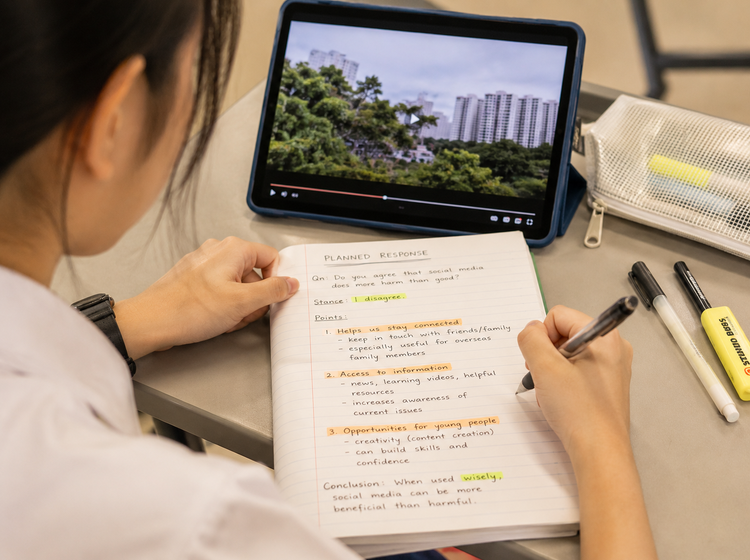
1. Watch the Video With the Question in Mind
Read the prompt question before the video starts playing, so you know what to listen
out for. This shifts your focus from passive viewing to purposeful note-taking. If
the question asks whether you agree with a particular view, pay attention to moments
in the video that support or challenge that view.
You will usually watch the video twice. Use the first viewing to understand the
overall message and the second to identify useful details and examples.
2. Plan a Clear Structure Before You Speak
Decide on your stance early, then build two or three supporting points around it with clear
examples. A simple structure works well: begin with your main view, develop your strongest
point first, follow with another supporting idea, then end with a brief reflection or
recommendation.
Avoid writing full sentences in your notes. Short bullet points help your delivery sound
natural instead of rehearsed.
3. Use Specific Examples That Go Beyond the Video
You will not score well by simply describing what happens in the video. Strong responses
draw on personal experiences, school life, current affairs, or real-world observations
connected to the topic.
A response that links the discussion to a real situation in Singapore or a meaningful
personal example demonstrates maturity and engagement. Avoid vague statements such as
“young people today” or “society nowadays”. Specific examples make
your ideas more convincing.
4. Vary Your Sentence Structure and Vocabulary
Mix shorter sentences with longer ones that explain or connect ideas using words such as because,
although, and however. This helps your response sound fluent and thoughtful rather than
repetitive or flat.
Use precise vocabulary where possible. Instead of repeating broad words such as “good”
or “bad”, choose more specific alternatives such as “beneficial”,
“harmful”, or “effective”.
5. Close With Reflection Rather Than Repetition
End with a short reflective statement instead of repeating your earlier points. A thoughtful
closing line helps your response feel complete and leaves a stronger impression on the
examiners.
For example: “While social media can create distractions, I believe it can still be
valuable when used responsibly.”
Spoken Interaction: How to Approach It
In Spoken Interaction, examiners assess how well you communicate your perspectives, respond to questions, and engage in a natural discussion. Strong responses show active listening, clear reasoning, and the ability to develop ideas thoughtfully in real time.
1. Listen Carefully Before You Speak
Make sure you fully understand the examiner’s question before answering. A
short pause to think is far better than giving a quick but irrelevant response. If
you are unsure about the question, it is acceptable to ask politely for
clarification, for example, “Could you repeat the question, please?”
Careful listening also helps you pick up on the examiner’s tone and the
direction of
the discussion.
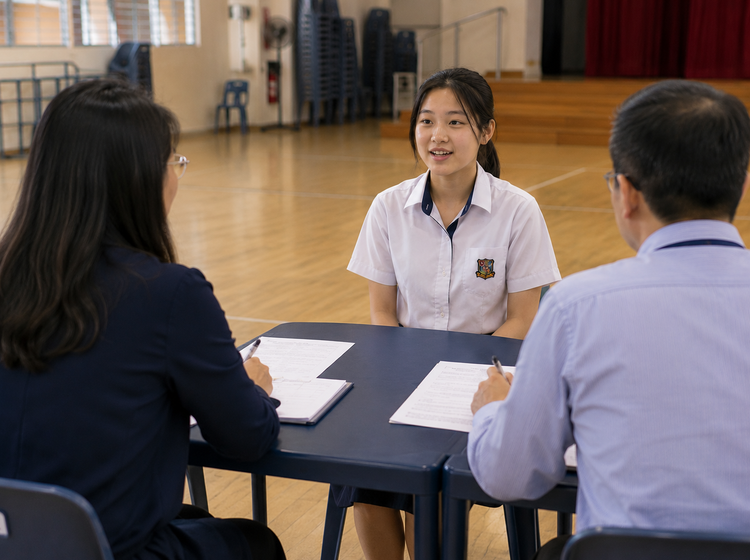
2. Develop Each Point With Reasons and Examples
Treat each answer as a short discussion point: state your opinion, explain your reasoning,
and support it with an example. One-line answers can make the conversation feel limited,
while developed responses give examiners more opportunities to engage with your ideas.
Go beyond surface-level comments. If you describe something as “stressful”,
explain what causes the stress and who it affects.
3. Engage With the Examiner’s Ideas
Respond directly to the examiner’s comments and follow-up questions instead of
treating each question separately. This helps the discussion feel natural and
conversational.
Phrases such as “That is a fair point, but I also think…” or “I
understand that perspective, although it may depend on…” show that you are
listening carefully and responding thoughtfully.
4. Be Open to Refining Your Views
You do not need to defend the same opinion throughout the discussion. It is perfectly
acceptable to adjust or refine your viewpoint if the conversation introduces a new
perspective, as long as you explain your reasoning clearly.
Statements such as “On reflection, I think…” or “That is a
perspective I had not considered before…” demonstrate maturity and flexibility
in thinking.
5. Keep Your Tone Natural and Conversational
Speak as you would in a thoughtful discussion with a teacher rather than in a rehearsed
speech. Natural pacing, clear pronunciation, varied intonation, and steady eye contact all
help you sound confident and engaged.
Avoid slang, overly rehearsed phrases, or incomplete sentences. The goal is to sound
polished, clear, and genuine.
Common Themes in O Level English Oral
The O Level English Oral examination commonly features topics based on everyday issues, current affairs, and experiences relevant to students in Singapore and around the world.
| Theme | Example Topics |
|---|---|
| Youth and society | Social media use, peer pressure, youth volunteering, screen time |
| Environment | Recycling, climate change, sustainable living |
| Education and learning | Study habits, exam stress, lifelong learning, technology in classrooms |
| Family and relationships | Family bonding, communication across generations, caregiving |
| Health and well-being | Sleep, mental health, physical fitness, healthy eating |
| Technology and the future | Artificial intelligence, automation, digital literacy, online safety |
| Community and culture | Local heritage, multiculturalism, civic responsibility, volunteering |
Familiarising yourself with these common themes through reading, following the news, and discussing current issues can help you develop stronger examples and more thoughtful responses for both Planned Response and Spoken Interaction.
How to Prepare for the O Level English Oral Examination
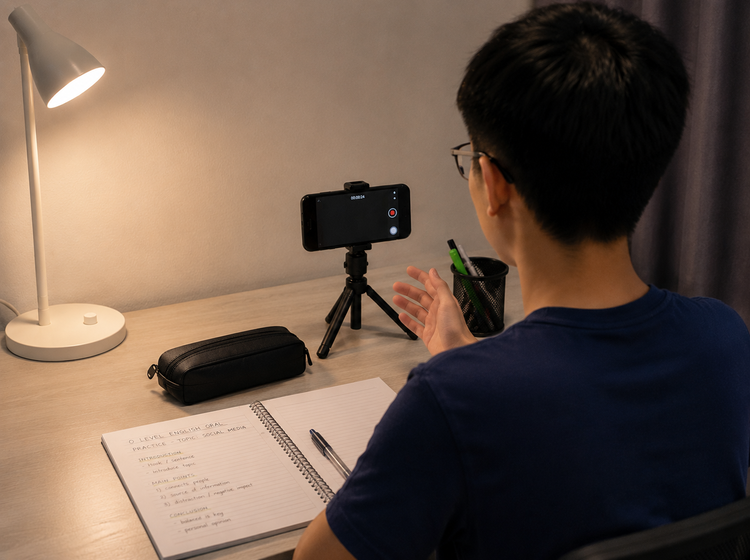
Preparing well for the O Level English Oral examination requires consistent speaking practice and exposure to real-world topics, not last-minute memorisation of model answers. The habits below can help you build the speaking and discussion skills that examiners look for.
1. Read Widely and Follow English News
Reading and speaking skills are closely connected. Students who read
widely often develop stronger vocabulary, clearer ideas, and more confident
responses during oral discussions.
Make it a habit to read opinion articles, follow reputable English news sources, and
listen to podcasts on topics commonly discussed in the exam.
2. Record Yourself and Listen Back
Use your phone to record short responses to oral practice questions. Listen carefully to
your pace, clarity, pronunciation, and use of filler
words.
Many students are surprised by how often they say “um”, “like”, or “you
know” once they hear themselves speaking.
3. Practise With a Partner or Tutor
Spoken Interaction is designed to assess discussion skills, so regular conversation practice
is important. Practise with a parent, sibling, classmate, or tutor who can ask follow-up
questions and challenge your ideas thoughtfully.
These discussions help you develop the listening, responsiveness, and confidence needed
during the exam.
4. Build Topic-Specific Vocabulary
For common themes such as technology, education, and the environment, build a small
vocabulary bank of useful nouns, verbs, and linking phrases.
Using precise and varied vocabulary helps you express ideas more clearly and confidently
during both Planned Response and Spoken Interaction.
5. Simulate Exam Conditions
In the weeks leading up to the exam, complete several full oral practice sessions under
timed conditions. Watch a short video, prepare notes within 10 minutes, deliver a two-minute
response, and follow it with a discussion.
Ask your practice partner to play the role of examiner by asking follow-up questions and
challenging your viewpoints naturally.
Sample O Level English Oral Questions
Here are examples of how the same video topic can be used for both Planned Response and Spoken Interaction in the O Level English Oral examination.
Example 1
Video topic: A short video about teenagers in Singapore spending several hours a day on social media.
| Component | Question | Strong Response |
|---|---|---|
| Planned Response | “Do you think social media has a positive or negative effect on teenagers in Singapore today?” |
|
| Spoken Interaction | “How can parents and schools help teenagers use social media more responsibly?” |
|
Example 2
Video topic: A short video about students participating in a community recycling project in Singapore.
| Component | Question | Strong Response |
|---|---|---|
| Planned Response | “Do you think schools should play a bigger role in encouraging students to care for the environment?” |
|
| Spoken Interaction | “What more can young people in Singapore do to live more sustainably?” |
|
English and Future Success
Studies have found that strong English skills go far beyond the classroom, playing a key role in
university1 and career success2. Better English proficiency is not just about grammar and
vocabulary; it provides a crucial stepping stone for achieving life goals.
At Creative Campus, we believe that nurturing strong English skills lays the groundwork for your child’s future
success. Our rigorously developed in-house curriculum not only seeks to enhance language proficiency but also
fosters critical thinking, creativity, and confidence. Through engaging lessons and dedicated guidance, we equip
students with the tools they need to excel academically and beyond. Ready to unlock your child’s full potential?
Contact us today to book a trial class and see how we can make a
difference!

About Ms Geraldine Chew

DIRECTOR OF PROGRAMMES (SECONDARY AND GENERAL PAPER)
CHIEF EXECUTIVE OFFICER
DIRECTOR OF TEACHER INSTRUCTION
Frequently Asked Questions (FAQs)
Planned Response is a prepared spoken response of up to two minutes to a question based on a short video clip, while Spoken Interaction is a five-minute discussion with the examiners on a topic related to the same video. Planned Response assesses how clearly you organise and express your ideas, whereas Spoken Interaction focuses on how well you listen, respond, and develop ideas in real time. Each component is worth 15 marks, giving Paper 4 a total of 30 marks.
The O Level English Oral preparation time is approximately 10 minutes, during which you watch a short video clip, read the Planned Response question, and prepare notes. Use this window to decide your stance, plan two or three supporting points, and jot down a brief closing line. Avoid writing full sentences, as short bullet phrases help your delivery sound natural rather than rehearsed during the two-minute response.
The O Level English Oral covers everyday themes drawn from contemporary life in Singapore and beyond, including youth and society, the environment, education, family, health and well-being, technology, and community and culture. Topics often touch on current affairs such as social media use, climate change, mental health, and digital literacy. Familiarity with these themes through reading and watching the news helps you develop stronger examples and viewpoints.
You can prepare for the O Level English Oral at home by reading widely, following English-language news, and practising spoken responses regularly. Record yourself answering practice prompts, then listen back for pace, clarity, and filler words. Discuss current issues with family or a tutor who can ask follow-up questions, and simulate full exam conditions with a video clip, ten minutes of preparation, and a two-minute response.
The O Level English Oral is marked out of 30, split equally between Planned Response (15 marks) and Spoken Interaction (15 marks). Planned Response is graded on Response (10 marks, covering development, organisation, and expression of ideas) and Delivery (5 marks, covering pronunciation, fluency, and intonation). Spoken Interaction is graded on how clearly you communicate your perspectives and how effectively you engage in discussion with the examiners.
No, you should not memorise answers for the O Level English Oral, as examiners can easily tell when a response sounds rehearsed rather than genuine. Memorised speeches also tend to fall apart under follow-up questions during Spoken Interaction. Instead, build a strong topic vocabulary, practise structuring ideas clearly, and rehearse responding to a range of prompts so that you can think and respond flexibly on exam day.
You will typically be allowed to watch the video clip more than once during the preparation time for the oral examination. Use the first viewing to grasp the overall message and theme, and the second viewing to capture specific details, examples, or quotes that could support your Planned Response. Make brief notes during both viewings rather than trying to remember everything from a single watch.
Yes, you can take notes during the 10-minute preparation time for the O Level English Oral examination, and you can refer to them during your Planned Response. Keep your notes as short bullet phrases rather than full sentences, so your delivery sounds natural rather than read aloud. Notes are most useful for capturing your main stance, two or three supporting points, and a brief closing reflection.
If you do not understand the examiner’s question during the O Level English Oral, it is acceptable to politely ask for clarification with a phrase such as “Could you repeat the question, please?” A short pause to think is also far better than launching into a quick but irrelevant answer. Examiners value candidates who listen carefully and respond thoughtfully rather than rush to fill the silence.
Your accent does not affect your O Level English Oral score, as examiners assess clarity, fluency, intonation, and intelligibility rather than how closely you sound like a native speaker. What matters is that the examiners can understand you easily and follow your ideas. Speaking too softly, mumbling, or using unclear pronunciation can cost you marks, but an accent itself is not penalised in any way.
If you disagree with the examiner during Spoken Interaction, you can respectfully share a different view as long as you explain your reasoning clearly. Phrases such as “That is a fair point, but I also think…” help you engage thoughtfully without sounding dismissive. Examiners reward candidates who can hold their own opinions, support them with examples, and stay open to refining their views as the discussion develops.
The O Level English Oral differs from the PSLE English Oral in stimulus, format, and depth. PSLE uses a photograph for Stimulus-based Conversation, while O Level uses a short video clip followed by Planned Response and Spoken Interaction. O Level also expects more developed reasoning, broader use of examples, and longer engagement with the examiner, reflecting the more mature thinking required at upper-secondary level.