
IP English Tuition Singapore
IP English Tuition Singapore
The Integrated Programme is the fast track through Singapore's top schools, bypassing
the O-Levels so students head straight for the A-Levels or IB. That freedom brings an
accelerated, demanding pace, and English is easily neglected until it quietly holds a
student back.
Our IP English tuition keeps pace with that rigour and adds depth, drawing on A-Level,
IB, and IP material to build the analytical thinking and sophisticated writing these
students need.
With educators who bring 10 to over 25 years of experience, we help your child stay
ahead and grow the independent, confident voice that carries through to A-Levels and
beyond.
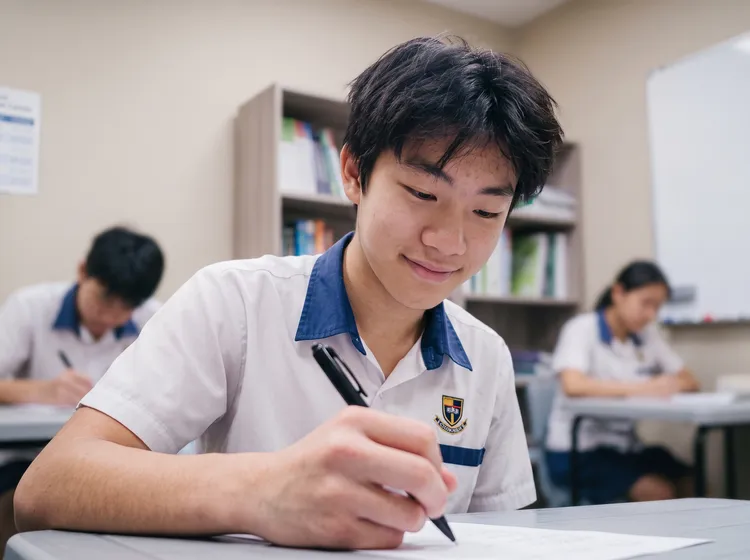

In my experience, an able child with no O-Levels ahead of them can quietly coast, and the IP's fast pace only widens the gaps that go unnoticed. I have never seen a student as a mere face in the crowd; we work with each child's strengths and prescribe the methods and techniques they need to think, write and argue for themselves. That, done with care, is how an IP student gains not just results, but the confidence to carry an independent voice through to A-Levels and beyond.
Director of Programmes, Secondary & General Paper
How IP English Differs from O-Level English
IP English is set and marked by the individual school, while O-Level English is set by the Singapore Examinations and Assessment Board (SEAB) and sat by every candidate in the country.
| Aspect | Integrated Programme English | O-Level English |
|---|---|---|
| Who sets the syllabus | The individual school | SEAB, under English Language Syllabus 1184 |
| How it is assessed | School-designed continual assessments and end-of-year papers, with no national examination at Secondary 4 | Four national papers with published mark weightings, taken at the end of Secondary 4 |
| Final qualification | A-Level or the IB Diploma at the end of six years | GCE O-Level at the end of Secondary 4 |
| Variation between schools | Considerable, as each school designs its own curriculum | None, as all candidates sit for the same papers |
As each IP school writes its own curriculum, no programme can match any one school's syllabus
exactly.
What transfers across every IP school is the underlying skill set: reading an unfamiliar text
closely, building an argument that holds, and writing about it with precision. Those are the
skills we teach, and they are the same skills the A-Level General Paper and IB Language and
Literature will test later.
What Our IP English Tuition Covers
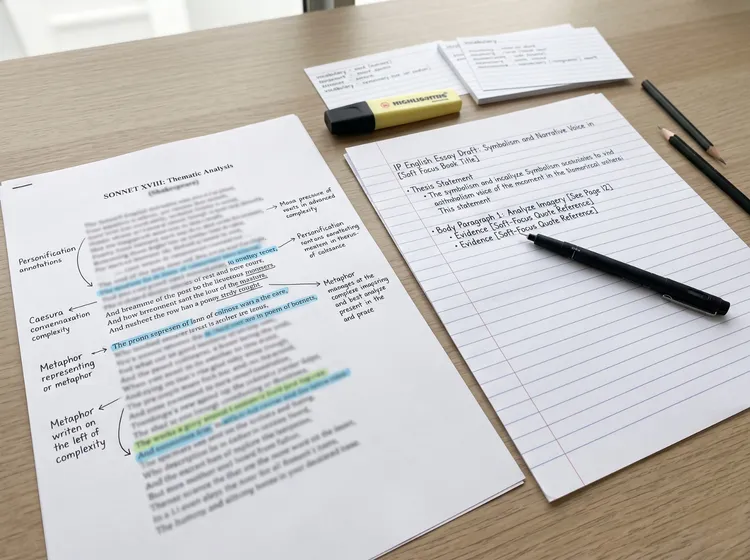
Drawing on the O-Level, IB and IP syllabuses, our curriculum teaches the components below across all levels, with depth and difficulty rising each year.
Essay Writing
Discursive, narrative and descriptive writing, with a focus on argument construction in discursive essays
Unseen Poetry and Prose
Close reading of unfamiliar texts and structured commentary writing
Comprehension
Inference, tone and writer's intent across literary and non-literary texts
Summary
Selecting and compressing relevant content within a set word limit
Oral Communication
Clarity of spoken expression, discussion and presentation
We also run dedicated GP Tuition and IB Tuition programmes, so students can continue with the same teaching team through to their final examinations.
Lower Secondary IP English Tuition
Lower secondary is where students learn the habits that everything later builds on. Essay
writing, unseen texts, comprehension, summary and oral communication all start in Secondary 1,
but the texts are shorter and the questions give more help, so students learn how to read closely
and argue clearly before the work gets harder.
By Secondary 2, students work with less help and longer texts, and have to reach their own view
rather than be led to one. It is a good year to work on weak spots, because there is
time to act on feedback before the work steps
up.
Upper Secondary IP English Tuition
Upper secondary teaches the same components at a harder level. The texts are less familiar, the
questions are more open, and students have to hold an argument together over a longer piece and
choose their own evidence to support it.
By Secondary 4, students are writing at close to the standard the final two years expect, and the
transition into Year 5 is a continuation rather than a fresh start.
IP English Tuition for Years 5 and 6
By Years 5 and 6, students are writing for the A-Level General Paper or the IB Diploma, and the
work shifts towards sustained argument on contemporary issues and analysis of unseen texts under
time pressure.
We teach the same components at that level, through our GP Tuition and IB Tuition classes, with
the same teaching team.
Schools Offering the Integrated Programme (IP)
We teach students from all of Singapore's Integrated Programme schools, including those that lead to the IB Diploma:
- Anglo-Chinese School (Independent)
- Catholic High School
- Cedar Girls' Secondary School
- CHIJ St. Nicholas Girls' School
- Dunman High School
- Hwa Chong Institution
- Methodist Girls' School
- Nanyang Girls' High School
- National Junior College (Secondary)
- NUS High School of Mathematics and Science
- Raffles Girls' School
- Raffles Institution
- River Valley High School
- Singapore Chinese Girls' School
- St. Joseph's Institution
- Temasek Junior College (Secondary)
- Victoria School
Our classes are grouped by level rather than by school, so students work alongside others at the same stage from different IP schools and routes. Feedback is personalised, so the guidance each student receives is shaped by their own writing and the specific areas they need to work on.
Why Choose Creative Campus for IP English Tuition?
A curriculum already built for IP students
Our programme draws on the O-Level, IB and IP syllabuses, giving students a broader grounding than any single syllabus offers.
Taught 20 to 30% above national syllabus levels
Pitched to match the rigour of IP school assessments.
Small class sizes
Personalised feedback on every piece of work, and the time to speak up, argue a point and read aloud to build confidence.
Teachers with 10 to over 25 years of experience
Every one of our English educators has taught the subject for at least a decade.
Our Secondary School Curriculum is both designed and taught by Ms Geraldine Chew, the former English Curriculum Lead and Head Trainer at The Learning Lab (1999 to 2011), and an ex-lawyer from renowned firms like Harry Elias & Partners and KhattarWong Partnership.
With over 25 years of passionate dedication to education, Ms Chew and her teaching team infuse each lesson with exceptional expertise, lively student engagement, and genuine dedication.
Former English Curriculum Lead and Head Trainer at The Learning Lab (1999 to 2011)
Passionate Educator with over 25 years of experience
Trained over 200 English educators
Former lawyer at Harry Elias & Partners / Khatter Wong Partnership


What Our Students Say

“I've been a part of Creative Campus from Primary 3 to JC2. Throughout my journey, I've been privileged to learn from astoundingly talented educators who combine passion with a genuine care for the students. Their commitment transcends expectations, making Creative Campus an experience that you should genuinely consider.”
Rachel Wong Si Yin
NUS Medicine Student

“As a Secondary 4 student at Creative Campus, I began my journey here in Secondary 2. Over the last one and a half years, I've witnessed significant improvements in my English. My gratitude goes out to the teachers who always ensure that our lessons are both enriching and captivating through continuous student engagement.”
Sophie Tan
Secondary 4 Student

“From Primary 5 to JC2, I had the privilege of being under Ms Chew's guidance at Creative Campus. Those pivotal years were incredibly formative. Every facet of her classes, from insightful news sharings to stimulating classroom material, was designed to challenge and cultivate our appreciation for literature and language. She inspired us to view the world through a broader, more critical lens. Ms Chew's feedback was consistently sharp and enlightening, aiding me in refining the structure and articulation of my arguments.”
Zheng Zhixin
University College London, Geography
National Library Board Scholarship Recipient
Our Google Reviews
Our IP English Tuition Class Schedule
Our IP English tuition class schedule is as follows:
| Campus | Level | Day | Time |
|---|---|---|---|
| East | General Paper | Saturday | 5:00PM to 7:00PM |
| Orchard | General Paper | Saturday | 12:00PM to 2:00PM (FULL) |
| Orchard | General Paper | Saturday | 2:15PM to 4:15PM |
| East | Secondary 1 | Tuesday | 7:30PM to 9:30PM |
| East | Secondary 1 | Friday | 7:00PM to 9:00PM (FULL) |
| East | Secondary 1 | Saturday | 1:00PM to 3:00PM |
| Orchard | Secondary 1 | Wednesday | 5:00PM to 7:00PM |
| Orchard | Secondary 1 | Thursday | 4:30PM to 6:30PM (MIN 2 TO START) |
| East | Secondary 2 | Friday | 7:00PM to 9:00PM (FULL) |
| East | Secondary 2 | Saturday | 1:00PM to 3:00PM |
| Orchard | Secondary 2 | Wednesday | 5:00PM to 7:00PM |
| Orchard | Secondary 2 | Thursday | 4:30PM to 6:30PM (MIN 2 TO START) |
| Orchard | Secondary 2 | Saturday | 4:15PM to 6:15PM |
| East | Secondary 3 | Friday | 7:00PM to 9:00PM |
| East | Secondary 3 | Saturday | 3:00PM to 5:00PM |
| Orchard | Secondary 3 | Wednesday | 7:00PM to 9:00PM (MIN 2 TO START) |
| Orchard | Secondary 3 | Saturday | 12:00PM to 2:00PM |
| Orchard | Secondary 3 | Saturday | 2:15PM to 4:15PM |
| East | Secondary 4 | Friday | 7:00PM to 9:00PM |
| East | Secondary 4 | Saturday | 3:00PM to 5:00PM |
| Orchard | Secondary 4 | Wednesday | 7:00PM to 9:00PM (MIN 2 TO START) |
| Orchard | Secondary 4 | Saturday | 12:00PM to 2:00PM |
| Orchard | Secondary 4 | Saturday | 2:15PM to 4:15PM |
Online IP English Tuition
Every IP English tuition class we run is hybrid, so students can attend in person, or join the
same lesson live online.
Online students follow the same curriculum and receive the same marked feedback as the students
in the room, which means a week away or a clash with a school commitment does not mean missing
the lesson.
IP English Tuition Price
| Class | Price* |
|---|---|
| IP English Tuition | From $103 / 2-hour lesson |
| Trial Class | Please enquire |
*All prices are before GST.
How Can I Sign Up for an IP English Tuition Class?
WhatsApp us at 8850 2499
WhatsApp UsEmail us at chalk@creativecampus.com.sg
Email UsCall us at 6455 3063
Call UsRequest A Call Back
Frequently Asked Questions
IP English is the English subject taught in Singapore's Integrated Programme, a six-year through-train route where students move from secondary school to A-Levels or the IB Diploma without sitting the O-Level. Each school designs and marks its own papers, so there is no single national syllabus. Most IP English work centres on close reading of unfamiliar texts, discursive writing and sustained argument.
No. IP students do not sit the O-Level at the end of Secondary 4. They are assessed instead through school-designed continual assessments and end-of-year papers, and progress directly into the final two years of the programme, finishing with either the A-Level or the IB Diploma. A student who transfers out of the Integrated Programme partway through would then follow the O-Level route.
Yes. We teach students from all of Singapore's Integrated Programme schools. As each IP school writes its own curriculum, no programme can match any one school's syllabus exactly, so we teach the skills every IP school assesses: close reading of unfamiliar texts, building an argument that holds, and writing with precision. Classes are grouped by level, and feedback is personalised to each student's own work.
Secondary 1 and 2 are the most useful years to start, since that is when the analytical and writing habits behind everything later are built, and there is time to act on feedback before the work steps up. Starting later still works, and we teach through to Years 5 and 6, though the focus shifts towards technique and sustained argument rather than groundwork.