
The PSLE is one of the biggest milestones in primary school, and the exam year can feel full of revision, practice papers and exam preparation. Even so, doing well usually has less to do with studying the hardest and more to do with studying consistently, following a clear plan and learning from your mistakes.
Along the way, you may hear many different study tips and strategies. Some of them will help, while others may add unnecessary pressure. The key is to find study methods that work consistently and stay with them over time. In the end, the PSLE rewards consistency more than panic.

Grades matter, but they are not everything. The habits built during this year, like managing time well, staying calm under pressure, and recovering from disappointing results, continue to matter long after the PSLE ends.
In this guide, we will walk through effective study habits, subject-specific revision
strategies, and practical ways to prepare for the PSLE.
How the PSLE AL Scoring System Works
The PSLE AL scoring system grades each of the four subjects from AL1 to AL8 according to the student’s raw mark. The four grades are then added together to give a total score between 4 and 32, where a lower score is better.
| AL Grade | Raw Mark Range |
|---|---|
| AL1 | 90 and above |
| AL2 | 85 to 89 |
| AL3 | 80 to 84 |
| AL4 | 75 to 79 |
| AL5 | 65 to 74 |
| AL6 | 45 to 64 |
| AL7 | 20 to 44 |
| AL8 | Below 20 |
For example, a student who scores:
- AL2 for English
- AL3 for Mathematics
- AL1 for Science
- AL2 for Mother Tongue
would receive a total PSLE score of 8.
This scoring system also affects how students should plan their revision. Every mark counts
because even a one-mark improvement can move a student into a higher AL grade.
This means students should pay close attention to subjects where their academic performance
usually sits just below the next AL grade. If a student is regularly scoring around 63 or 73,
spending extra revision time on that subject may improve the overall PSLE score more than
dividing the same amount of time equally across all four subjects.
What Scoring Well in the PSLE Actually Requires
Scoring well in the PSLE depends on several things working together: understanding the
syllabus, building strong fundamentals, applying what you know to unfamiliar questions, and
staying calm under exam pressure. Without these foundations in place, tuition, extended
study hours, or hard work may still not lead to strong results.
Although each subject tests different skills, there are a few areas that matter across all
four subjects:
Strong Understanding of Concepts
Understand the ideas behind what is being learnt, not just memorise steps or answer formats. In English, this means understanding how language affects meaning and tone. In Maths, it means knowing why a method works.
Applying Knowledge to Unfamiliar Questions
PSLE questions are often worded differently from textbook examples. Doing well means adapting what has been learnt to new question types, especially in English comprehension and Maths problem sums.
Accuracy Under Time Pressure
Work carefully within the exam time limit while avoiding careless mistakes. Manage time properly and stay focused when questions become difficult.
Clear Communication of Ideas
Many PSLE questions reward clear explanations and well-organised answers, especially in English composition and Science open-ended questions.
7 Practical Tips to Study for PSLE
A good PSLE study routine is one that can be followed consistently throughout the year, even during busy school weeks or after a disappointing test result. The goal is not to study every hour of the day, but to revise in a way that helps information stay in memory, improves exam skills, and steadily strengthens weaker subjects over time.
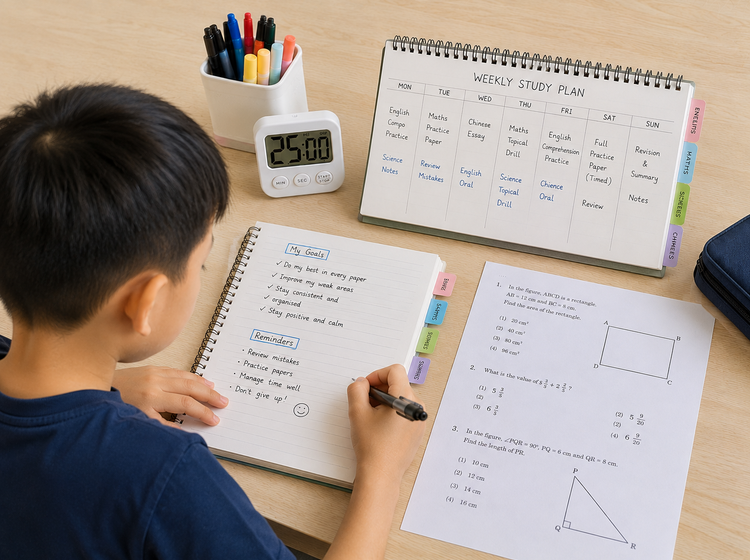
1. Spend More Time on Your Weakest Subject
Many students spend the most time on the subjects they already enjoy or do well in
because improvement feels faster there. However, stronger overall PSLE results often
come from improving weaker subjects instead.
This does not mean ignoring stronger subjects completely. The goal is to maintain
existing strengths while steadily improving weaker areas over time.
Tip: Use recent school exams or test results to identify which subject should receive more revision time each week.
2. Revise Topics More Than Once
Reading notes once is usually not enough for information to stay in memory. Stronger
revision comes from revisiting the same topic several
times across different days instead of trying to memorise everything in one sitting.
One useful revision method is retrieval practice,
which involves testing how much you can remember without looking at notes first. This often
strengthens memory better than simply rereading notes again and again.
Tip: After studying a topic, close the notes and write down everything that can be remembered before checking what was missed.
3. Practise Under Real Exam Conditions
From Term 2 onwards, full practice papers become more important. Doing timed papers helps
students build concentration, manage time better, and get used to the pressure of
the actual exam.
After each paper, do not focus only on the final score. Look carefully at the mistakes made.
Some mistakes happen because a topic is not fully understood, while others come from
careless reading or poor time management. Understanding the difference helps make revision
more effective.
Tip: Complete practice papers within the actual time limit, on paper, and without phones or distractions nearby.
4. Keep Track of Your Mistakes
One useful PSLE revision habit is keeping track of mistakes made during practice papers and
other revision exercises.
After a few weeks, students will often spot patterns in their mistakes. Some students
lose marks through careless mistakes, while others repeatedly struggle with certain topics or question types.
Reviewing these mistakes regularly can help prevent the same errors from happening again in
future practice papers and exams.
Tip: Keep a notebook or file containing questions answered wrongly, the correct method, and the reason the mistake happened.
5. Set Small Goals Each Week
Large goals like “study harder” are often too vague and difficult to follow
consistently. Smaller weekly goals are clearer and easier to manage.
Small weekly goals also make progress easier to track. Instead of wondering whether enough
revision was done, it becomes easier to see whether the tasks planned for the week were
completed.
Tip: Set weekly goals such as finishing two Maths papers, completing one English comprehension exercise, or memorising Science keywords for a topic.
6. Make Time for Rest and Sleep
Rest is an important part of effective revision. Without enough sleep, it becomes
harder to focus, remember information, and avoid careless mistakes.
It also helps to take proper breaks during the week. Short
periods of rest, exercise, hobbies, or time away from revision can make it easier to return
to studying with better focus and energy.
Tip: Set a fixed time each night to stop revision and start winding down for sleep. Plan difficult revision tasks earlier in the day instead of leaving them until late at night.
7. Ask for Help When Needed
Some students continue struggling with the same topics because they keep revising alone
without fully understanding where the problem is. Asking for help earlier can prevent
confusion from building up over time.
Help can come from teachers, parents, classmates, or structured support outside school.
Sometimes, a short explanation or guided practice session is enough to make a difficult
topic clearer and easier to manage.
Tip: If the same mistakes keep appearing after several rounds of practice, ask someone to explain the topic differently instead of repeating the same revision method.
Subject-by-Subject PSLE Strategies
Each PSLE subject tests different skills, so revision should be adjusted for each paper.
English: Build Skills Across All Four Papers
English is tested across four papers, so doing well requires consistent
performance across all components, not just one strong paper. Paper 1
tests writing, Paper 2 focuses on language use and comprehension, Paper 3 is Listening Comprehension, and Paper 4 is Oral Communication.
Many students spend less time preparing for Reading Aloud and
Stimulus-based
Conversation because they expect to “just speak naturally”
during the exam. However, regular oral practice from Term 2 onwards can improve
confidence and fluency.
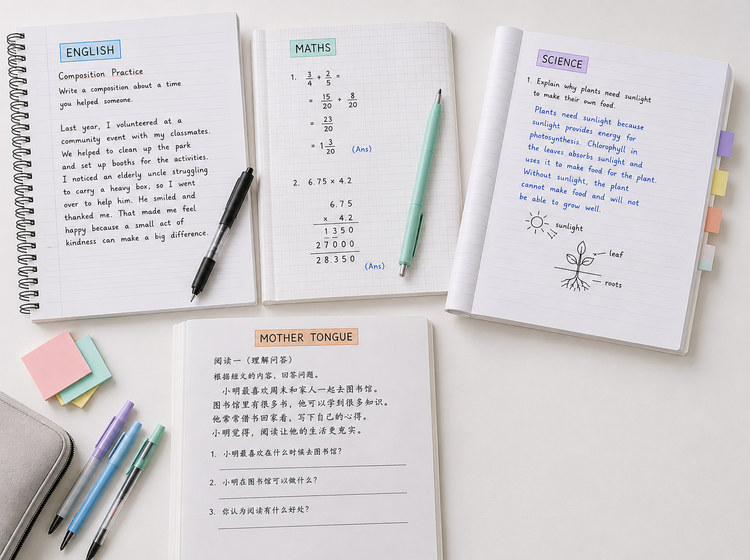
For Paper 2, practise sections like Synthesis and Transformation, Vocabulary Cloze, Grammar Cloze, and Comprehension Cloze regularly.
Reading English books, articles, and model compositions regularly can
also
help strengthen vocabulary and sentence structure over
time.
Mathematics: Focus on Understanding, Not Memorisation
The 2026 PSLE Mathematics syllabus places a stronger focus on understanding and applying
concepts. Memorising answer formats or model methods alone will not be enough for many
questions.
Understanding why a method works instead of only memorising the steps is key to improving in Mathematics. This
becomes especially important for problem sums that combine multiple topics or present
questions in unfamiliar ways.
When practising problem sums, it helps to explain the working clearly instead of writing
only the final answer. This builds stronger reasoning skills and reduces careless
mistakes.
Science: Explain Answers Clearly
The 2026 PSLE Science syllabus places more emphasis on reasoning and explanation. Many
open-ended questions reward students for identifying the correct concept and linking it
clearly to the information given in the question.
A common mistake is naming the concept without explaining how it connects to the data,
diagram, or situation provided.
Comparing answers with the model answer after each practice question can help students
notice missing keywords, incomplete explanations, or weak links between the concept and the
evidence.
Mother Tongue: Build Daily Exposure
Mother Tongue improvement
often comes from regular exposure rather than occasional long revision sessions. Reading,
listening, and speaking the language more often helps build vocabulary, confidence, and fluency over
time.
Daily exposure does not have to be complicated. Reading a short article, listening to a
short audio clip, or speaking in the language for ten to fifteen minutes each day can
gradually strengthen language skills more effectively than only doing worksheets once a
week.
How to Improve in Your Weakest PSLE Subject
Improving in a weaker subject starts with understanding why marks are being lost. Instead of repeatedly doing more practice papers, look through recent school tests or exams and group mistakes into different categories.
- Knowledge Gap — The concept or rule was not fully understood. Relearn the topic, make short notes, and practise similar questions again.
- Application Gap — The concept was understood, but applying it to unfamiliar questions was difficult. Focus on practising similar question types and reviewing model answers carefully.
- Careless or Comprehension Error — Marks were lost through misreading, skipping keywords, careless calculations, or copying mistakes. Build a habit of checking work carefully during every practice paper.
Without identifying the actual problem first, more practice can sometimes reinforce the same mistakes instead of fixing them.
Managing PSLE Stress

Some nervousness before the PSLE is normal. The goal is not to remove stress completely, but
to manage it in a healthy and practical way.
One simple way to remember healthy exam habits is the word CALMS:
- Cram less in the final weeks
- Arrange materials the night before
- Leave difficult questions and return later
- Manage stress with slow breathing
- Sleep well before each paper
In the final weeks before the PSLE, focus more on revising familiar topics instead of trying to learn large amounts of new content. Keeping a steady routine and familiar exam-day habits can also help reduce stress and improve focus.
Final Thoughts: Steady Progress, Not Perfection
The PSLE can feel overwhelming at times, but strong results usually come from steady habits
built over time rather than last-minute effort. Small improvements, consistent revision, and
learning from mistakes often matter more than trying to study perfectly every day.
The key is to find study routines and strategies that can be followed consistently while
staying healthy, rested, and focused throughout the year.
Most importantly, remember that the PSLE is only one stage of the learning journey. The
confidence, discipline, and resilience built during this period will continue to matter long
after the exam is over.
English and Future Success
Studies have found that strong English skills go far beyond the classroom, playing a key role in
university1 and career success2. Better English proficiency is not just about grammar and
vocabulary; it provides a crucial stepping stone for achieving life goals.
At Creative Campus, we believe that nurturing strong English skills lays the groundwork for your child’s future
success. Our rigorously developed in-house curriculum not only seeks to enhance language proficiency but also
fosters critical thinking, creativity, and confidence. Through engaging lessons and dedicated guidance, we equip
students with the tools they need to excel academically and beyond. Ready to unlock your child’s full potential?
Contact us today to book a trial class and see how we can make a
difference!

About Mrs Elizabeth Yeo

CHIEF OPERATING OFFICER
CHIEF FINANCIAL OFFICER
DIRECTOR OF PROGRAMME (PRIMARY LEVELS)
Frequently Asked Questions (FAQs)
There is no fixed number of hours that works for every student, since concentration and stamina vary. What matters more than total hours is the quality of revision: focused, distraction-free sessions usually beat long stretches that drift into rereading. Build in proper breaks, rotate subjects through the week, and protect sleep, since rest is when the brain consolidates what was learnt earlier in the day.
A good PSLE score is one that opens the secondary school pathway your child is aiming for. Each subject is graded AL1 to AL8 and the four grades add up to a total between 4 and 32, with lower being better. Most popular schools sit in the PSLE Score range of 8 to 14, while the most selective Integrated Programme schools usually require a score below 8. Use recent posting cut-offs as your benchmark.
Steady preparation from the start of Primary 6 is usually enough, although strong fundamentals built in earlier years make that year far less stressful. The most useful early step is building consistent revision habits rather than intensive cramming, since memory and skills strengthen across months, not weeks. If your child is significantly behind, starting earlier in Primary 5 gives more room to close gaps without burnout.
Tuition is not strictly necessary, although it can help students who need more structured guidance, targeted feedback, or support in specific subjects. Many students score well through consistent schoolwork, careful revision, and parental support. The decision depends on your child’s needs, learning style, and how comfortable they are seeking help when stuck. What matters most is having a plan that works, regardless of where the support comes from.
In the final stretch, focus on familiar routines rather than introducing new material or revision methods. Help your child sleep well, eat regular meals, and take short breaks between revision blocks. Avoid repeated reminders about scores or expectations, which can add pressure. Reassurance, patience, and a calm home environment often help more than extra study sessions. Encourage slow breathing or short walks if anxiety builds before each paper.
Catching up in Term 3 is possible, although the time pressure means revision must be more focused and selective. Prioritise topics that recur every year, practise full past papers under timed conditions, and use retrieval practice to retain more in less time. Concentrate on weaker areas where small improvements can move a subject up an AL grade. Consistency in these final months often matters more than starting earlier without a clear plan.
The AL score grades each subject from AL1 to AL8 based on raw marks, while the old T-score compared students against their cohort to produce a relative score. The AL system reduces the focus on small mark differences and tighter cohort rankings, since students within the same band are not separated by minor mark gaps. This change aims to encourage broader, more well-rounded learning rather than competitive fine-tuning of marks.
Start by understanding why marks are being lost, not by doing more practice papers. Group recent mistakes into knowledge gaps, application gaps, and careless errors, then target the largest category. Spend slightly more time on this subject without dropping others, take regular breaks, and review mistakes regularly instead of repeating the same exercises. Steady, focused improvement over the year usually delivers stronger results than long, exhausting study sessions that lead to burnout.