
What Is Comprehension Cloze?
Comprehension Cloze is a section in the PSLE English paper that tests your ability to fill in missing words in a passage using vocabulary, grammar, and contextual understanding. Comprehension Cloze differs from Grammar Cloze, which gives you a word bank and focuses on grammar rules. In Comprehension Cloze, there is no word bank, so you have to think of the correct word yourself.
That is what makes it one of the more challenging components of Paper 2. To fill each blank, you need to draw on your reading comprehension, vocabulary and knowledge of grammar rules at the same time.
In this article, we explain how Comprehension Cloze works and share 5 techniques that will help you approach each blank with confidence.
PSLE Comprehension Cloze Format
Comprehension Cloze appears in Booklet B of PSLE English Paper 2, which covers language use and comprehension. The section is worth 15 marks and consists of a passage with 15 blanks.
- Each blank is worth 1 mark.
- There is no word bank provided. You must supply the correct word yourself.
- Only one acceptable answer is expected per blank, and it must be grammatically correct and suit the context of the passage.
- Spelling must be accurate to receive the mark.
What Does Comprehension Cloze Assess?
Comprehension Cloze assesses how well you can understand a passage and use the right
word to complete it, rather than testing grammar in isolation.
It is a key component of the Primary 6 English
assessment because it reflects how students process and respond to written language as a
whole.

Each blank is designed to test one or more of the following skills:
- Understanding what the passage is about and how ideas connect
- Choosing a word that fits the meaning of the sentence
- Using correct grammar, such as tense, subject-verb agreement, and articles
- Recognising collocations (words that naturally go together) and phrasal verbs (verb phrases where the meaning changes depending on the word that follows)
- Figuring out the answer by making inferences, which means using clues in the surrounding sentences to work out the missing word
A word might be grammatically correct but still wrong if it does not match the meaning of the passage, so reading carefully matters just as much as knowing your grammar rules.
Common Comprehension Cloze Answer Types
Here are the main types of answers tested in Comprehension Cloze, along with what each one requires and an example:
| Answer Type | What It Requires | Example |
|---|---|---|
| Grammar-based | Filling in articles, prepositions, pronouns, conjunctions, or verbs in the correct tense. |
She had been waiting for nearly an hour.
Less suitable answers – since, at. |
| Vocabulary-based | Choosing a word that fits the meaning of the sentence precisely. |
My family and I were getting ready at the departure gate to board
the plane bound for Tokyo.
Less suitable answers – door, airport, counter. |
| Collocations | Using word combinations that naturally go together in English. |
He decided to take a different approach.
Less suitable answers – use, make. |
| Phrasal verbs | Filling in verbs made up of two or more words, like "give up" or "look after", where the meaning changes depending on the preposition that follows. |
The teacher asked them to hand in their homework.
Less suitable answers – up, down. |
| Contextual or inferential | Working out the answer from clues found elsewhere in the passage, not just the immediate sentence. |
Although he smiled, his trembling voice suggested that he was
upset.
Less suitable answers – sound, holler, dialogue. |
Comprehension Cloze Techniques
Here are five techniques you can use to tackle Comprehension Cloze passages more effectively:
1. Read the Entire Passage First
Read the full passage from start to finish before filling in any blanks.
Many students make the mistake of trying to answer each blank as they go, but this often
leads to errors because clues for one blank may appear several sentences later.
Focus on understanding the overall topic, tone, and sequence of events. Once you have a
clear picture of what the passage is about, the blanks become much easier to fill.
2. Use Contextual Clues
Look for hints in the words and sentences surrounding each blank.
Contextual clues are the most reliable way to determine the correct answer, especially for
blanks that test vocabulary or require you to work out the meaning from the passage
(inferential blanks).
Ask yourself:
- What is the sentence trying to say?
- Are there words nearby that suggest a contrast, a cause, or a sequence?
- Does the sentence before or after give away the meaning?
For example, if the sentence reads "Despite the rain, they ___ to play outside", the word "despite" signals contrast, so the missing word is likely "continued" or "chose."
3. Identify the Type of Word Needed
Determine the word class (noun, verb, adjective, preposition, etc.) before deciding
on the answer.
Looking at the sentence structure around the blank tells you what kind of word fits
grammatically.
- A blank after "the" or "a" usually needs a noun or adjective + noun (e.g., "a big surprise").
- A blank after a subject (e.g., "She ___") usually needs a verb (e.g., "She walked home").
- A blank between two clauses often needs a conjunction or connector (e.g., "He was tired but he kept going").
- A blank before a noun may need an article or adjective (e.g., "The weather was cold"; "It was a sunny day").
Narrowing down the type of word needed first prevents you from choosing a word that makes sense in meaning but does not fit the grammar of the sentence.
4. Check for Collocations and Fixed Expressions
Think about whether the blank is part of a common word pairing or phrase.
English has many fixed expressions where certain words naturally go together, and
Comprehension Cloze passages frequently test these.
Common examples include:
- make a decision (not "do" a decision)
- pay attention (not "give" attention)
- take part in (not "join" part in)
- burst into tears (not burst "in" tears)
Reading widely helps you build familiarity with these patterns. The more you encounter them in stories, articles, and everyday texts, the more naturally they come to mind during the exam.
5. Review Your Answers in Context
After filling in all the blanks, read the completed passage from beginning to
end.
This final step helps you catch errors you might have missed, especially answers that are
grammatically correct on their own but do not fit the flow of the passage.
As you read through, check:
- Does each sentence sound natural?
- Is the tense consistent throughout the passage?
- Does the passage make logical sense as a whole?
If a word feels awkward or breaks the rhythm of the passage, reconsider it. Sometimes a small change, such as switching from "but" to "however" or from "happy" to "pleased", makes all the difference.
How to Improve at Comprehension Cloze
1. Read Widely and Regularly
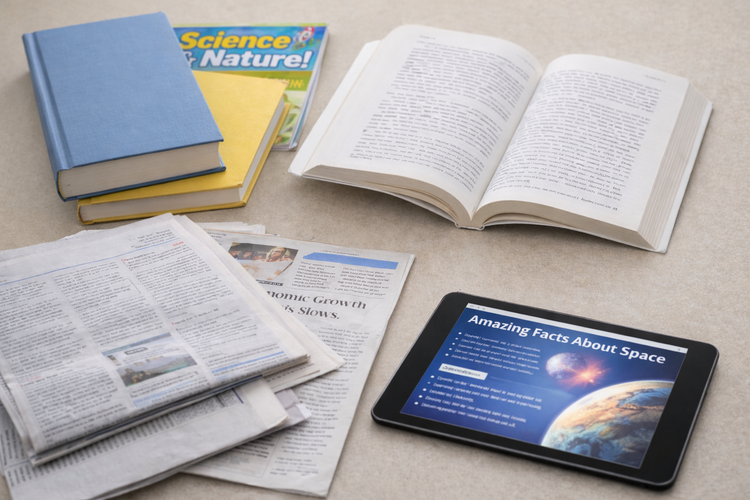
Exposure to different types of texts, from fiction to news articles, builds
vocabulary and helps you recognise how words are used in context. Students at every
level, from Primary 3 to
Primary 5, benefit from
developing this habit early.
Try to read for at least 15 to 20 minutes a day, and mix up what
you read. Storybooks, newspapers, magazines, and even informational texts all
introduce different vocabulary and sentence patterns.
2. Learn Words in Context, Not in Isolation
When you come across a new word, note the sentence it appears in. This helps you remember
not just what the word means, but how it is used. Keep a vocabulary notebook or use a notes
app on your phone to write down the word, the sentence you found it in, and a short meaning
in your own words.
Over time, this builds a personal word bank that is far more useful than memorising
dictionary definitions.
3. Practise with Past Papers and Timed Exercises
Working through actual Comprehension Cloze passages under exam conditions can help to
build accuracy and speed. Set a timer and try to complete each passage within the time you
would have during the exam.
After finishing, review your mistakes carefully to identify patterns. Are you struggling
more with collocations, grammar-based blanks, or inferential blanks? Focusing your practice
on your weak areas makes each session more effective.
4. Build Your Knowledge of Collocations and Phrasal Verbs
Keep a list of common word pairings and expressions you encounter in your reading. These
appear frequently in Comprehension Cloze and are difficult to guess without prior exposure.
When you spot a collocation or phrasal verb, write it down with an example sentence.
Reviewing this list regularly helps these expressions become second nature, so you can
recall them quickly during the exam.
5. Strengthen Your Grammar Foundations
While Comprehension Cloze is not purely a grammar test, many blanks still require correct
tense, articles, prepositions, or sentence
connectors. A solid grammar foundation makes these blanks straightforward. If you
find yourself unsure about basic grammar rules, spend time revising one topic at a time.
For example, practise verb tenses for a week, then move on to prepositions. Strengthening
these building blocks makes the rest of Comprehension Cloze much easier to handle.
Comprehension Cloze Practice Exercise
Fill in each blank with a suitable word (15 marks).
Last Saturday, Marcus and his classmates visited the Singapore Science Centre (1) ___ part of their school's learning journey. Their teacher, Mrs Lim, had reminded them to bring along a notebook so that they could write (2) ___ anything interesting they observed during the visit.
When they arrived, Marcus was immediately drawn to the exhibition on space exploration. He had always been fascinated (3) ___ the solar system and had read several books about it. The exhibition featured a large model of the planets, and Marcus spent a long time studying it (4) ___ his classmates moved on to the next section.
The group then made their way to the robotics hall, (5) ___ they had the chance to watch a live demonstration. A scientist showed them how a small robot could be programmed to carry (6) ___ simple tasks, such as picking up objects and placing them in a box. Marcus was so impressed that he decided he wanted to (7) ___ up robotics as a hobby.
(8) ___ the demonstration ended, the students were given time to explore on their (9) ___. Some of them headed to the gift shop, while others preferred to revisit their favourite exhibits. Marcus, (10) ___, chose to stay in the robotics hall. He wanted to ask the scientist a few questions (11) ___ he had been curious about.
The scientist was happy to speak with him and patiently explained how robots were being used in hospitals to (12) ___ doctors during surgery. Marcus listened carefully and wrote down every detail in his notebook. He felt (13) ___ he had learned more in that one conversation than from any textbook.
On the bus ride home, Mrs Lim asked the (14) ___ to share their thoughts about the trip. When it was Marcus's turn, he spoke so enthusiastically about robotics that even his classmates who had not visited that section became interested. It was clear that the visit had left a deep (15) ___ on him.
Suggested Answers & Explanations
- as – Collocation: "as part of" is a fixed expression.
- down – Phrasal verb: "write down" means to record something.
- by – Grammar-based: "fascinated by" is the correct preposition pairing.
- while – Grammar-based: "while" connects two actions happening at the same time.
- where – Grammar-based: "where" is a relative adverb referring to a place (the robotics hall).
- out – Phrasal verb: "carry out" means to perform or complete a task.
- take – Phrasal verb: "take up" means to start a new hobby or activity.
- After – Grammar-based: "After" indicates what happened next in the sequence of events.
- own – Collocation: "on their own" means independently or by themselves.
- however – Vocabulary-based: "however" signals a contrast between what Marcus did and what the others did.
- that – Grammar-based: "that" introduces a relative clause referring to the questions.
- assist – Vocabulary-based: "assist" means to help, and it fits the formal context of surgery.
- as if – Contextual/inferential: "as if" introduces a comparison, suggesting the conversation felt more valuable than a textbook.
- students – Vocabulary-based: "students" refers to the class members whom Mrs Lim asks to share their thoughts.
- impression – Collocation: "left a deep impression" is a fixed expression meaning something had a strong effect on someone.
English and Future Success
Studies have found that strong English skills go far beyond the classroom, playing a key role in
university1 and career success2. Better English proficiency is not just about grammar and
vocabulary; it provides a crucial stepping stone for achieving life goals.
At Creative Campus, we believe that nurturing strong English skills lays the groundwork for your child’s future
success. Our rigorously developed in-house curriculum not only seeks to enhance language proficiency but also
fosters critical thinking, creativity, and confidence. Through engaging lessons and dedicated guidance, we equip
students with the tools they need to excel academically and beyond. Ready to unlock your child’s full potential?
Contact us today to book a trial class and see how we can make a
difference!

About Mrs Elizabeth Yeo

CHIEF OPERATING OFFICER
CHIEF FINANCIAL OFFICER
DIRECTOR OF PROGRAMME (PRIMARY LEVELS)
Frequently Asked Questions (FAQs)
A cloze test for reading comprehension is a passage with missing words that you need to fill in using your understanding of the text. In PSLE English Paper 2, the Comprehension Cloze section appears in Booklet B and consists of a passage with 15 blanks worth 15 marks. There is no word bank provided, so you must rely on your vocabulary, grammar, and ability to understand the passage to determine the correct word for each blank.
To do well in Comprehension Cloze, read the entire passage before filling in any blanks so you understand the overall meaning first. Use contextual clues from surrounding sentences to guide your answers, and identify the type of word needed for each blank, whether it is a noun, verb, conjunction, or another word class. Check for collocations and fixed expressions, and always review the completed passage at the end to make sure every answer fits both the grammar and meaning of the passage.
Grammar Cloze focuses on grammar rules and provides a word bank for you to choose from. It has 10 blanks worth 10 marks. Comprehension Cloze does not provide a word bank, so you must come up with the correct word on your own. It has 15 blanks worth 15 marks and tests vocabulary, grammar, and contextual understanding together, making it the more challenging of the two components.
Reading widely builds vocabulary and helps you recognise how words are used in context, which is exactly what Comprehension Cloze tests. Exposure to different types of texts, from fiction to news articles, helps you become familiar with collocations, phrasal verbs, and natural sentence patterns. The more you read, the easier it becomes to recall the right word during the exam without needing a word bank.
The five types are grammar-based, vocabulary-based, collocations, phrasal verbs, and contextual or inferential. Grammar-based blanks test articles, prepositions, pronouns, conjunctions, or verb tenses. Vocabulary-based blanks require a word that fits the meaning precisely. Collocations test word combinations that naturally go together. Phrasal verbs test verb phrases like "give up" or "hand in". Contextual or inferential blanks require you to work out the answer from clues found elsewhere in the passage.
Practise with past papers and timed exercises to build accuracy and speed. Read widely and regularly to grow your vocabulary, and keep a notebook or notes app to record new words, collocations, and phrasal verbs along with example sentences. Review your mistakes after each practice to identify which types of blanks you find most difficult, then focus your revision on those areas. Strengthening your grammar foundations in areas like verb tenses, articles, and prepositions also helps, since many blanks still test these rules.