
What Is Reading Aloud in the PSLE English Oral?
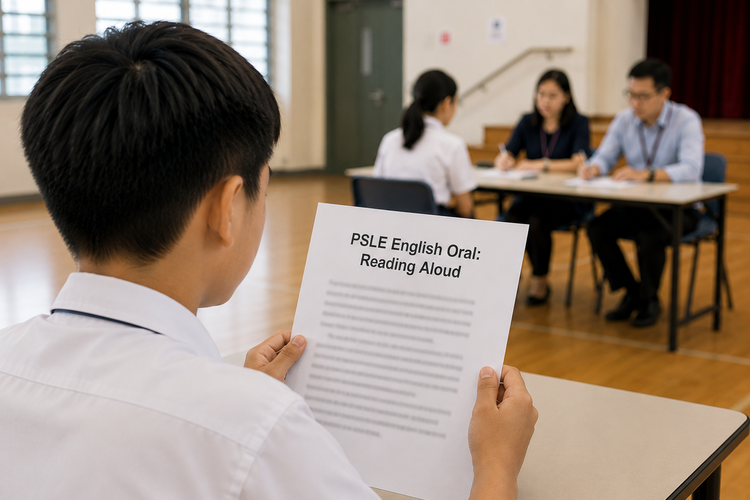
Reading Aloud is the first part of the PSLE English Paper 4 Oral Communication examination, and it comes before Stimulus-based Conversation. You are given a short passage, usually 150 to 200 words long, to read clearly and expressively to the examiner. It may include narration, dialogue, instructions or descriptive writing.
At Primary 6 level, you are expected to recognise and read the words accurately, but how you deliver the passage matters more. Good delivery means pronouncing words clearly, pacing your sentences naturally and adjusting your tone so the passage sounds engaging and meaningful to the listener.
In this article, we will go through what the Reading Aloud component assesses, the strategies that work best during the examination, and how to practise effectively at home.
PSLE Reading Aloud Format
Reading Aloud is worth 15 out of the 40 marks for Paper 4: Oral
Communication.
The oral examination process typically goes as follows:
- You are given five minutes to prepare silently before entering the examination room. During this preparation time for both oral components, you should read through the Reading Aloud passage and familiarise yourself with the visual stimulus for the Stimulus-based Conversation.
- At the end of the five minutes, you will be asked to read the passage aloud to the examiner(s). This usually takes about one to two minutes.
Note: From 2025 onwards, the Reading Aloud passage and the Stimulus-based Conversation picture are no longer thematically linked, so they may cover completely different topics.
What PSLE Oral Reading Aloud Assesses
Reading Aloud assesses how fluently and expressively you read a passage with clear and accurate pronunciation, while adjusting your delivery to suit the purpose, audience and context of the text.
- Fluency — reading at a steady, natural pace without unnecessary pauses, false starts, or stopping word by word.
- Expression — varying your tone, volume, and pace to match the meaning of the passage, including emotion in dialogue and emphasis on key ideas.
- Pronunciation — saying each word clearly and accurately, including consonant endings and unfamiliar names.
- Suitability to purpose, audience and context — adjusting how you read to fit the type of passage, so a news report sounds different from a story, and a set of instructions sounds different from a speech.
A strong reader sounds like someone sharing a story with a listener, rather than someone reading word by word.
Common Types of Reading Aloud Passages
PSLE Reading Aloud passages are drawn from a range of passage types, each requiring a slightly different style of delivery. Recognising the passage type quickly during preparation helps you choose the right tone before you start reading.
| Passage Type | Typical Content | Delivery Style |
|---|---|---|
| Narrative | A short story extract with characters, action, and sometimes dialogue. | Storytelling tone, with a clear distinction between narration and dialogue. |
| Descriptive | A passage that paints a setting, scene, or character in detail. | Calm, steady pace with emphasis on imagery and sensory details. |
| Informational | A factual piece on a topic such as nature, science, history, or current events. | Clear and steady, like a news presenter, with emphasis on key terms. |
| Instructional | A set of steps, directions, or guidelines. | Clear pacing between steps, with mild emphasis on action verbs. |
| Persuasive | A passage that argues a viewpoint or encourages a behaviour. | Confident, persuasive tone with emphasis on key points. |
5 Strategies for PSLE English Oral Reading Aloud
1. Use the Preparation Time to Read for Meaning
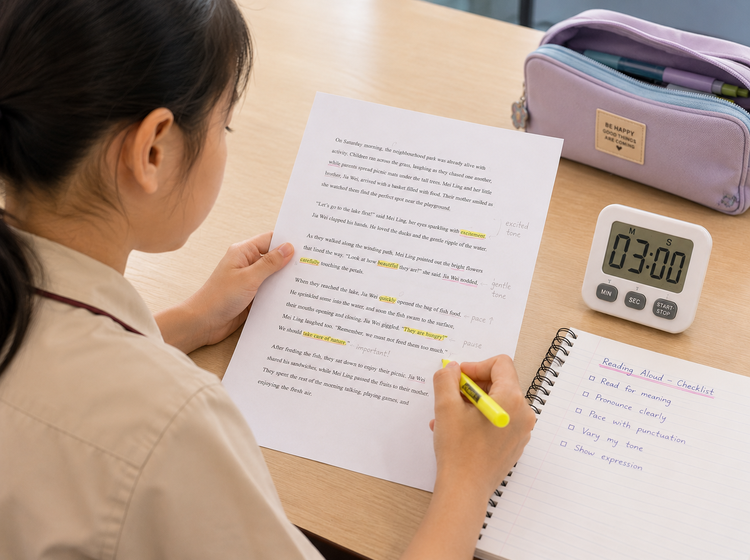
Before thinking about how to read the passage, make sure you understand it. During
the preparation time, read the passage silently and identify what is happening, who
is speaking, and the mood the writer wants to convey.
Mentally note difficult words, names, or places where punctuation signals a shift in
tone, such as exclamation marks, question marks, or speech in quotation marks.
A reader who understands the meaning naturally reads with the right expression
because understanding the passage helps guide the voice.
2. Pronounce Each Word Clearly and Completely
Articulate your consonant endings instead of dropping
them. Many students say “wan” instead of “want”, “han” instead of “hand”, or “kep” instead of “kept”. These small
omissions are noticeable to examiners and can lower marks across the passage.
Watch out for words with silent letters, such as knee, hour, and lamb,
as well as tricky vowel pairs like bear, beard, and fear. If you spot
an unfamiliar name during preparation, decide how you will pronounce it and stick with that
pronunciation throughout.
3. Pace Yourself with the Punctuation
Let punctuation guide your pace, not your nerves. Commas signal a brief pause, full stops
signal a longer pause, and paragraph breaks give you time to take a slightly longer breath
before continuing.
Many students rush because they are anxious,
which causes them to swallow their words and lose marks for expression. A calm, steady pace
that is slower than ordinary conversation gives the examiner time to hear your pronunciation
clearly and gives you time to think about the next phrase.
4. Vary Your Tone to Match the Passage
Match the rise and fall of your voice to what is happening in the passage. Questions usually end with a rising tone and statements with a falling tone. Express excitement or surprise with a louder, more energetic delivery.
If the passage includes dialogue, distinguish the spoken lines from the narration by
adjusting your tone when characters speak. You do not need to imitate the characters'
voices. A small change is enough to show the examiner that you understand the structure of
the passage.
5. Stay Calm if You Stumble
If you mispronounce a word or trip over a sentence, correct yourself quickly and continue.
Examiners expect occasional slips. What matters is how calmly you recover.
A brief correction is far better than a long pause or a flustered restart.
Avoid making faces, sighing, or commenting on your mistakes. Your composure is part of what
the examiner is assessing.
How to Improve at Reading Aloud
The best preparation happens in the months before the exam, not the night before.
1. Read Aloud for Ten to Fifteen Minutes Daily
Make reading aloud part of your daily routine, even when the exam still feels far
away. Pick a short text each evening, whether from a storybook, newspaper article,
or school reader, and read it aloud as if you are speaking to a listener.
Regular practice trains the muscles you use for clear speech and helps your brain
connect reading with speaking. Research on classroom reading has shown that
consistent reading aloud practice strengthens oral reading fluency in primary-aged
readers.

2. Record Yourself and Listen Back
Use your phone to record yourself reading, then listen to the recording carefully. You will
quickly notice habits that are difficult to hear while reading, such as speaking too
quickly, dropping consonants, or trailing off at the end of sentences.
After listening, read the same passage again with one specific improvement in mind. Targeted
practice is more useful than rereading the same passage without a clear focus.
3. Practise Reading with Someone Else
Ask someone to listen and give you specific feedback. A second pair of ears can catch
mispronunciations and sections that sound flat, which you may miss on your own.
You can also take turns reading the same passage. Hearing someone else read the same passage
gives you fresh ideas for tone and pacing that you can apply to your own reading.
4. Read Widely to Build Confidence with Unfamiliar Words
The wider your reading, the fewer unfamiliar words you
are likely to encounter in the exam. Fiction helps you become more comfortable with
dialogue and emotion, while non-fiction builds your understanding of new vocabulary related
to different topics. News articles also expose you to current events, names, and formal
language.
Students who read across different genres often handle Reading Aloud and Stimulus-based
Conversation more confidently because they are already familiar with a wider range of
vocabulary, sentence structures, and speaking situations.
Sample P6 Reading Aloud Passages with Practice Notes
Sample 1
The classroom was unusually quiet. Mrs Tan stood at the front, holding a thick brown envelope. “I have your results,” she said, glancing slowly around the room. Aisha's heart began to pound. She had worked harder for this test than for any other, staying up late each night with her notes spread across the dining table. As Mrs Tan walked down the aisle, Aisha closed her eyes for a moment. “Aisha,” her teacher said warmly, placing the paper in front of her, “I think you'll be very pleased.”
| Passage Extract | Practice Notes |
|---|---|
| “The classroom was unusually quiet.” | Calm, steady tone. Pause slightly after “quiet” to set the mood. |
| “I have your results,” she said... | Use a steady, slightly serious tone for Mrs Tan's line. Distinguish the dialogue clearly from the narration. |
| “Aisha's heart began to pound.” | Slightly faster pace and a more anxious tone to suggest tension. |
| “She had worked harder... dining table.” | Reflective tone, with slight emphasis on “harder”, “late”, and “spread across”. |
| “Aisha,” her teacher said warmly... | Use a warmer tone for “warmly” and the line that follows. Slow down on “very pleased” for emphasis. |
Sample 2
Marcus adjusted the straps of his backpack as he stepped onto the nature trail. The air smelled of damp earth after the morning rain, and birds chirped loudly from the trees above. “Stay close to the group,” Mr Lim reminded the class as they crossed a narrow wooden bridge. Marcus nodded, though his eyes were already fixed on the fast-moving stream below. Suddenly, Mei Lin pointed towards the bushes. “Look!” she whispered excitedly. Perched on a low branch was a small kingfisher, its bright blue feathers shining in the sunlight.
| Passage Extract | Practice Notes |
|---|---|
| “Marcus adjusted the straps of his backpack...” | Calm, steady tone to introduce the setting and character. |
| “The air smelled of damp earth...” | Slow down slightly and emphasise descriptive details such as “damp earth” and “birds chirped loudly”. |
| “Stay close to the group,” Mr Lim reminded the class... | Use a firmer, guiding tone for Mr Lim's dialogue. |
| “Marcus nodded, though his eyes...” | More curious tone to build anticipation. |
| “Look!” she whispered excitedly. | Show excitement through a brighter tone while keeping the volume controlled because of the word “whispered”. |
| “Perched on a low branch...” | Read more slowly and smoothly to highlight the beauty of the final image. |
English and Future Success
Studies have found that strong English skills go far beyond the classroom, playing a key role in
university1 and career success2. Better English proficiency is not just about grammar and
vocabulary; it provides a crucial stepping stone for achieving life goals.
At Creative Campus, we believe that nurturing strong English skills lays the groundwork for your child’s future
success. Our rigorously developed in-house curriculum not only seeks to enhance language proficiency but also
fosters critical thinking, creativity, and confidence. Through engaging lessons and dedicated guidance, we equip
students with the tools they need to excel academically and beyond. Ready to unlock your child’s full potential?
Contact us today to book a trial class and see how we can make a
difference!

About Mrs Elizabeth Yeo

CHIEF OPERATING OFFICER
CHIEF FINANCIAL OFFICER
DIRECTOR OF PROGRAMME (PRIMARY LEVELS)
Frequently Asked Questions (FAQs)
The PSLE English Reading Aloud passage is typically 150 to 200 words long. It may be a narrative, descriptive, informational, instructional, or persuasive piece, and it is no longer thematically linked to the Stimulus-based Conversation picture. The passage is short enough to be read aloud in about one to two minutes, depending on your pace and the type of text you are given.
Reading Aloud carries 15 marks out of the 40 marks for Paper 4: Oral Communication. The examiner listens for how fluently and expressively you read, how clearly and accurately you pronounce each word, and how well your delivery suits the purpose, audience, and context of the passage. These qualities are considered together to produce your final score, rather than being marked separately.
You get five minutes of preparation time before entering the examination room. This time is shared between both oral components, so you should read the Reading Aloud passage silently, identify difficult words and punctuation cues, and also familiarise yourself with the Stimulus-based Conversation picture.
You should read slightly slower than your normal speaking pace, but not so slowly that your reading sounds unnatural. A calm, steady pace gives the examiner time to hear your pronunciation clearly and lets you respond to the punctuation in the passage. Rushing causes students to swallow consonant endings and lose expression, while reading too slowly can sound mechanical and disconnected from the meaning.
If you mispronounce a word, correct yourself quickly and continue reading. Examiners expect occasional slips and look at how calmly you recover, not whether you read perfectly. A brief, composed correction is better than a long pause, a flustered restart, or commenting on your mistake. Avoid sighing, making faces, or apologising, as your composure is part of what is being assessed.
Your accent does not affect your Reading Aloud score as long as your pronunciation is clear and easy to understand. Students are not expected to imitate a particular accent. What matters is pronouncing words accurately, articulating consonant endings clearly, stressing words correctly, and reading with appropriate fluency and expression.
Your child can practise by reading aloud for ten to fifteen minutes each day from a storybook, newspaper article, or school reader. Recording the reading on a phone and listening back helps them notice unclear pronunciation or unnatural pacing. Taking turns reading with someone else can help build confidence and provide honest feedback. Reading widely across fiction, non-fiction, and news also expands vocabulary and exposure to different text types.
Read dialogue with a small shift in tone to distinguish it from the narration, but without imitating the character's voice. A slight change in pitch, pace, or volume is enough to show the examiner that you understand who is speaking and how they feel. For example, an excited line can be slightly louder and faster, while a serious or calm line can be softer and steadier.
If you see an unfamiliar word, try your best to work out the pronunciation during the preparation time and decide how you will say it. During the reading, say the word confidently and continue instead of stopping repeatedly to correct yourself. What matters most is staying calm and reading smoothly, even when you come across difficult words or names.
You do not need to make eye contact while reading aloud. Your focus should be on the passage itself, since you are being assessed on how clearly and expressively you read. A natural posture, calm body language, and a steady voice are more important than looking up at the examiner. Eye contact becomes more relevant during the Stimulus-based Conversation, where you respond directly to the examiner's questions.
You can re-read a short word or phrase to correct a stumble, but you should not re-read entire sentences. Going back too often disrupts the flow of your reading and can lower your fluency score. A quick, calm correction is enough. If you mispronounce a word, the cleanest approach is to repeat just that word correctly and continue moving forward through the passage.
You should read with appropriate expression rather than strong, dramatic emotion. The amount of expression depends on the type of passage, so a story with dialogue may sound more expressive while an informational passage should sound calmer and steadier. What matters is varying your tone, volume, and pace naturally to match the meaning of the passage without sounding exaggerated or forced.
Reading Aloud at Primary 6 level focuses on fluent and expressive reading rather than simply recognising and saying words correctly. By Primary 6, the examiner expects students to read accurately, so greater attention is given to pronunciation, fluency, expression, and matching the tone to the type of passage. Lower primary reading aloud usually focuses more on reading words correctly, while Primary 6 Reading Aloud requires a more confident and natural style of delivery suited to different types of texts.
Long, unnecessary pauses can lower your fluency score because Reading Aloud is assessed on how naturally and steadily you read. However, short pauses at commas, full stops, and paragraph breaks are expected and actually improve your delivery. The key is to let punctuation guide your pauses rather than your nerves. Pausing briefly to breathe is fine; pausing because you are unsure of the next word is what loses marks.
PSLE English Reading Aloud and PSLE Mother Tongue oral reading both assess fluency, pronunciation, and expression, but in their respective languages. English uses different phonics, intonation patterns, and consonant endings that students must articulate clearly. The Mother Tongue equivalent focuses on tones, rhythm, and accurate pronunciation of characters or words in Chinese, Malay, or Tamil. Each paper is marked separately by examiners trained in that language.