
PSLE English Paper 1 Format & Marks Breakdown
PSLE English Paper 1 is the Writing paper, worth 50 marks in total
and lasting 1 hour 10 minutes. It has two parts: Situational
Writing (14 marks) and Continuous
Writing (36 marks).
Continuous Writing is the composition, the component we will discuss here in greater
detail. Students are given one topic with three pictures, and you
write a story of at least 150 words based on at least one of them.
The topic is a theme, not a fixed story. The three pictures provide different
scenarios to develop the essay, so two students can choose the same picture, but
still write very different narratives. Markers look at your content and your
language, that is, how interesting your narrative is; and your language skills in
grammar, spelling, punctuation and introducing vocabulary.
Common PSLE English Composition Topics and Themes
Most PSLE composition topics ask about familiar everyday values, like kindness, honesty and perseverance. The exact wording changes each year, but similar ideas come up often. If you learn to spot them, you can prepare a few flexible stories and adapt them to whatever appears.
| Theme | What it asks you to show |
|---|---|
| Kindness and consideration | Thinking of others and helping them |
| Honesty and keeping your word | Doing the right thing and keeping promises |
| Teamwork and friendship | Working with others and valuing friends |
| Gratitude and celebration | Being thankful and sharing happy moments |
| Perseverance and change | Not giving up and improving yourself |
| New experiences | Trying something for the first time |
| Solving a problem | Facing a problem and putting it right |
Past-Year PSLE English Composition Topics: Analysis and Tips
| Year | Composition topic | How to approach it |
|---|---|---|
| 2025 | Being thankful |
|
| 2024 | Trying something new |
|
| 2023 | A change for the better |
|
| 2022 | A long wait |
|
| 2021 | A promise |
|
| 2020 | Something that was lost |
|
| 2019 | A celebration |
|
| 2018 | Teamwork |
|
| 2017 | A special gift |
|
| 2016 | A secret |
|
| 2015 | Being considerate |
|
Tips to Score Well in PSLE English Composition
- Read all three pictures first – Look at every picture before you choose, not just the first one. Pick the picture that gives you the most ideas and fits a story you have practised.
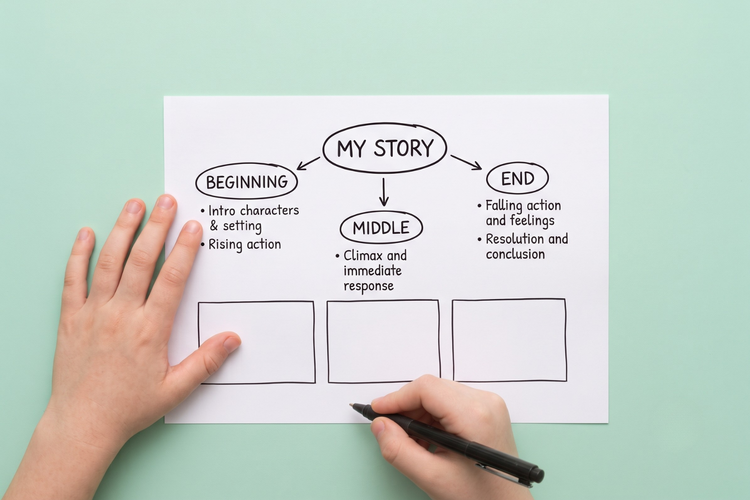
- Plan before you write – Spend about five minutes planning your beginning, middle and end. Know your character, their problem, and how it is solved before you start. Aim for four to six paragraphs, with the middle being the longest part, where the build-up and main moment happen.
- Use your chosen picture in the story – Your story must be based on at least one picture, so make it a key part of your story, not just a detail you mention in passing. Show the object or place doing real work in the plot.
- Show feelings with details – Instead of writing “I was scared”, show it: “My hands shook and my heart raced”. This makes your story come alive, and introducing good vocabulary or phrases at this point helps improve your language marks.
- Check your work at the end – Save a few minutes to reread your composition and fix any spelling, punctuation and tense mistakes before time runs out.
English and Future Success
Studies have found that strong English skills go far beyond the classroom, playing a key role in
university1 and career success2. Better English proficiency is not just about grammar and
vocabulary; it provides a crucial stepping stone for achieving life goals.
At Creative Campus, we believe that nurturing strong English skills lays the groundwork for your child’s future
success. Our rigorously developed in-house curriculum not only seeks to enhance language proficiency but also
fosters critical thinking, creativity, and confidence. Through engaging lessons and dedicated guidance, we equip
students with the tools they need to excel academically and beyond. Ready to unlock your child’s full potential?
Contact us today to book a trial class and see how we can make a
difference!

About Mrs Elizabeth Yeo

CHIEF OPERATING OFFICER
CHIEF FINANCIAL OFFICER
DIRECTOR OF PROGRAMME (PRIMARY LEVELS)
Frequently Asked Questions (FAQs)
Exact PSLE composition topics rarely repeat word for word, but the underlying themes can resurface. Values like kindness, honesty and perseverance appear across many years in different wording, so topics like “a promise” and “being thankful” can share the same core idea. This is why it helps to prepare flexible stories around common themes rather than trying to guess the exact topic, which is not something you can reliably predict.
No, you only need to base your story on at least one of the three pictures. You may use one, two or all three, whichever best fits the story you want to tell. Most students choose the one or two pictures that suit their ideas and use those well, rather than forcing all three in. Whichever you pick, make the picture a real part of the plot, not just a detail mentioned once.
The most effective preparation is regular, timed practice paired with feedback on each piece. Have your child read widely to build vocabulary and story ideas, practise planning a story in about five minutes, write full compositions of at least 150 words under examination conditions, and leave at least five minutes to check your story for grammar, spelling and punctuation errors. Preparing a few flexible stories around common themes helps too, and working with a teacher who can give targeted feedback often improves writing faster than practising alone.
The most common mistakes in PSLE Paper 1 Continuous Writing are drifting off the topic, putting in too many events, and using big words or long sentences wrongly. A story built around one clear main problem and developed well usually scores better than one with several events that stay underdeveloped. It is safer to write in simple, correct English than to force in difficult words that lead to grammar and tense mistakes. Ensure every part of your story links back to the topic.