
What Is O Level Editing?
O Level Editing is a 10-mark grammar section in GCE O Level English Paper 1.
In this section, you read a short continuous text and identify grammatical errors in selected lines. Each time you spot an incorrect word, you must write the correct answer while keeping the original meaning of the sentence.
In Continuous Writing and Situational Writing, you produce your own writing. Editing asks something different: you read like an editor, checking each line closely, finding the error and writing a clear correction that keeps the writer’s intended meaning.
In this guide, we explain the format of the section and the common O Level Editing error types, then show you a step-by-step answering approach. A sample passage with worked answers follows, so you can practise straight away.
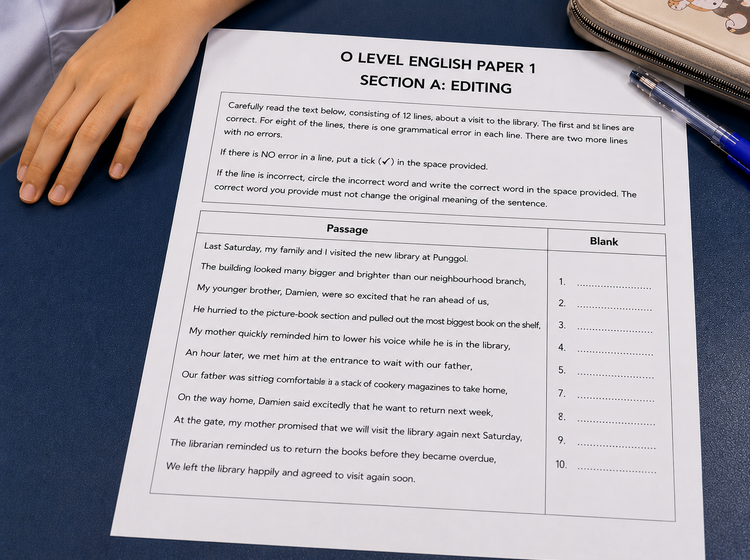
O Level Editing Format
The Editing section is the first section in O Level English Paper 1 and carries 10
of
the paper’s 70 marks. It consists of a short continuous text of not more
than 250 words, presented in 12 numbered lines.
The first and last lines are always correct and are not tested. For the remaining 10 lines,
eight contain one grammatical error each, while two lines have no error. If a line has an
error, you identify the incorrect word and write the corrected word in the answer column.
If a line has no error, you put a tick in the answer space according to the instructions
provided.
Each correct answer is worth one mark, and there are no half marks. Students should spend
no more than 10 minutes on this section so they have enough time for
Situational Writing and Continuous Writing.
What Does O Level Editing Assess?
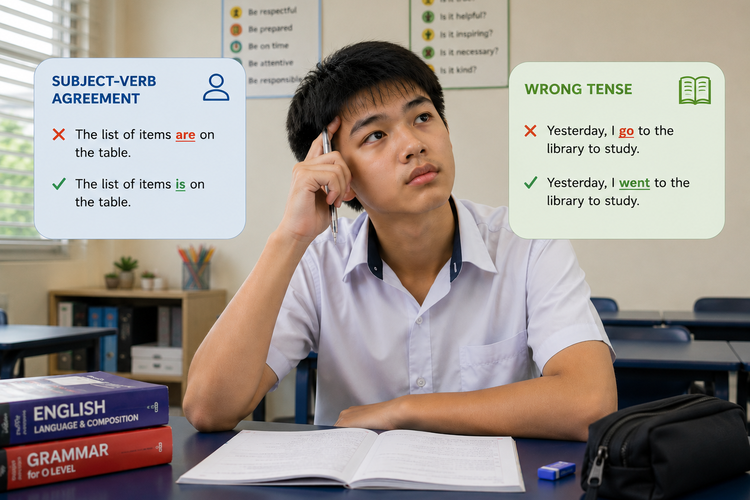
O Level Editing assesses your control of English grammar in context. The section focuses on grammar, not spelling, punctuation or capitalisation.
Specifically, it tests whether you can:
- Read a continuous text carefully and understand its overall meaning and tense.
- Decide whether each tested line contains a grammatical error or no error.
- Identify errors involving subject-verb agreement, tense, articles, prepositions, pronouns and word forms.
- Write the correct word without changing the original meaning of the sentence.
- Put a tick when a line has no error, if the instructions require it.
Common Types of Errors in O Level Editing
Most O Level Editing errors fall into a small group of grammar categories that appear regularly in exams. Learning these basic grammar rules and applying them carefully helps you identify errors more accurately and approach Editing questions with greater confidence.
| Error Type | What It Requires | Example |
|---|---|---|
| Subject-Verb Agreement | Matching the verb to a singular or plural subject correctly. |
Incorrect: The group of students were late. Correct: The group of students was late. |
| Tense | Keeping verbs consistent with the time of the passage. |
Incorrect: Yesterday, we go to the museum. Correct: Yesterday, we went to the museum. |
| Articles | Choosing between a, an and the correctly. |
Incorrect: She is a honest girl. Correct: She is an honest girl. |
| Prepositions | Using the correct preposition for the phrase or expression. |
Incorrect: He is good in mathematics. Correct: He is good at mathematics. |
| Pronouns | Matching pronouns correctly to the noun they refer to. |
Incorrect: Sarah lost his wallet. Correct: Sarah lost her wallet. |
| Word Form | Using the correct form of a word, such as a noun, verb, adjective or adverb. |
Incorrect: She spoke quick during the debate. Correct: She spoke quickly during the debate. |
| Conjunctions | Choosing the correct word to connect ideas logically. |
Incorrect: I was tired, and I kept working. Correct: I was tired, but I kept working. |
| Quantifiers | Using words like much, many, fewer and less correctly. |
Incorrect: There were less mistakes this time. Correct: There were fewer mistakes this time. |
| Comparatives and Superlatives | Using comparative and superlative forms correctly without combining them. |
Incorrect: She is the most tallest in her class. Correct: She is the tallest in her class. |
| Plurals | Matching singular and plural nouns correctly. |
Incorrect: He bought two loaf of bread. Correct: He bought two loaves of bread. |
5 Strategies to Tackle O Level Editing Questions
A steady approach to the Editing section helps you avoid careless mistakes and finish in time to focus on Situational Writing and Continuous Writing in Sections B and C.
1. Read the Whole Passage Before You Start Editing
Read the entire passage once before correcting any line. This gives you a clearer
sense of the topic, overall tense and tone of the passage.
These clues help you check whether the tense, pronouns and word choices are
consistent throughout the text. Without reading the full passage first, you may make
a correction that does not fit the rest of the paragraph.
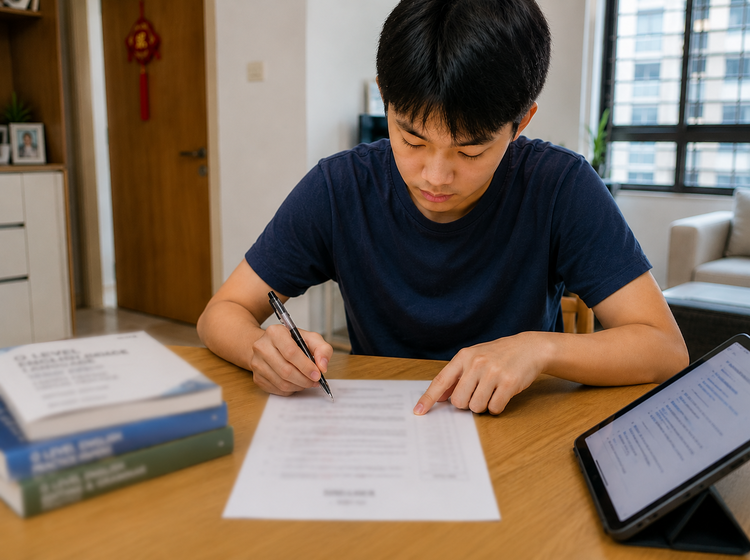
2. Treat Each Line as One Grammar Problem
Each tested line contains either one grammar error or no error. Read the line carefully and
check the common error types, such as subject-verb agreement, tense, articles, prepositions
and word form.
If a word sounds incorrect, try reading the corrected version silently in your head. The
line should sound natural and grammatically correct after the change.
3. Check the Surrounding Sentences for Clues
Some grammar errors only become obvious when you read the lines before and after them. A
line may look correct on its own, but the tense or pronoun may not match the rest of the
passage.
If you cannot find the error immediately, read the surrounding lines again before deciding
on your answer.
4. Make Only the Necessary Correction
Write only the corrected word needed to fix the grammar error. Do not rewrite the whole sentence or add unnecessary words. Focus first on deciding whether the line contains an error or no error before making a correction.
5. Leave Time to Check Your Answers
Save a few minutes at the end to read the passage again with your corrections in place. The
passage should now read smoothly and sound natural.
If a line still sounds awkward, you may have identified the wrong error in that sentence.
O Level Editing Sample Passages
Try these practice passages. Each passage has 12 numbered lines. The first and last lines are correct and are not tested. Of the remaining 10 lines, eight contain one grammatical error each, while two lines have no error. Write the corrected word in the blank for lines with an error, and put a tick for lines with no error.
Sample 1
| Line | Passage | Blank |
|---|---|---|
| 1 | Last Saturday, my family and I visited the new library at Punggol. | |
| 2 | The building looked many bigger and brighter than our neighbourhood branch. | ____________________ |
| 3 | My younger brother, Damien, were so excited that he ran ahead of us. | ____________________ |
| 4 | He hurried to the picture-book section and pulled out the biggest book on the shelf. | ____________________ |
| 5 | My mother quickly reminded him to lower his voice while he is in the library. | ____________________ |
| 6 | An hour later, we met him at the entrance to wait our father. | ____________________ |
| 7 | Our father was sitting comfortable in a quiet corner near the magazines. | ____________________ |
| 8 | He had borrow three novels and a stack of cookery magazines to take home. | ____________________ |
| 9 | As we packed up, Damien said excitedly that he want to return next week. | ____________________ |
| 10 | At the gate, my mother promised that we will visit the library again next Saturday. | ____________________ |
| 11 | The librarian reminded us to return the books before they became overdue. | ____________________ |
| 12 | We left the library happily and agreed to visit again soon. |
Suggested Answers:
| Line | Correction | Explanation |
|---|---|---|
| 1 | Not tested | — |
| 2 | many → much | Quantifier error — use “much” with comparative adjectives. |
| 3 | were → was | Subject-verb agreement error — “Damien” is singular. |
| 4 | ✓ No error | — |
| 5 | is → was | Tense error — the passage is written in the past tense. |
| 6 | wait → wait for | Preposition error — the correct phrase is “wait for”. |
| 7 | comfortable → comfortably | Word form error — an adverb is needed to describe “sitting”. |
| 8 | borrow → borrowed | Verb form error — “had” must be followed by the past participle. |
| 9 | want → wanted | Tense error — the verb should match the past tense reporting verb. |
| 10 | will → would | Tense error — reported speech changes “will” to “would”. |
| 11 | ✓ No error | — |
| 12 | Not tested | — |
Sample 2
| Line | Passage | Blank |
|---|---|---|
| 1 | Last month, our class travelled to the Science Centre for a learning journey. | |
| 2 | Many students were excited because they had never saw the new exhibition before. | ____________________ |
| 3 | Our teacher reminded us to walk quiet through the entrance hall. | ____________________ |
| 4 | One of the exhibits were about renewable sources of energy. | ____________________ |
| 5 | The guide explained how solar panels can produce electricity even during cloudy weather. | ____________________ |
| 6 | My friend Amir was interested with the robotics display near the back of the hall. | ____________________ |
| 7 | He asked the guide several questions, and the guide answered them patiently. | ____________________ |
| 8 | Before leaving, each of the student had to return their visitor pass to the counter. | ____________________ |
| 9 | The trip was far more enjoyable then we had expected. | ____________________ |
| 10 | On the bus ride home, everyone agreed that the visit had been both fun and education. | ____________________ |
| 11 | Our teacher ask us to write a reflection when we returned to school. | ____________________ |
| 12 | We reached school before noon and thanked her for organising the trip. |
Suggested Answers:
| Line | Correction | Explanation |
|---|---|---|
| 1 | Not tested | — |
| 2 | saw → seen | Verb form error — “had” must be followed by the past participle. |
| 3 | quiet → quietly | Word form error — an adverb is needed to describe “walk”. |
| 4 | were → was | Subject-verb agreement error — “One” is singular. |
| 5 | ✓ No error | — |
| 6 | with → in | Preposition error — the correct phrase is “interested in”. |
| 7 | ✓ No error | — |
| 8 | student → students | Noun form error — “each of the” must be followed by a plural noun. |
| 9 | then → than | Word choice error — comparisons use “than”. |
| 10 | education → educational | Word form error — an adjective is needed after “fun and”. |
| 11 | ask → asked | Verb tense error — the passage is in the past tense. |
| 12 | Not tested | — |
English and Future Success
Studies have found that strong English skills go far beyond the classroom, playing a key role in
university1 and career success2. Better English proficiency is not just about grammar and
vocabulary; it provides a crucial stepping stone for achieving life goals.
At Creative Campus, we believe that nurturing strong English skills lays the groundwork for your child’s future
success. Our rigorously developed in-house curriculum not only seeks to enhance language proficiency but also
fosters critical thinking, creativity, and confidence. Through engaging lessons and dedicated guidance, we equip
students with the tools they need to excel academically and beyond. Ready to unlock your child’s full potential?
Contact us today to book a trial class and see how we can make a
difference!

About Ms Geraldine Chew

DIRECTOR OF PROGRAMMES (SECONDARY AND GENERAL PAPER)
CHIEF EXECUTIVE OFFICER
DIRECTOR OF TEACHER INSTRUCTION
Frequently Asked Questions (FAQs)
O Level Editing tests common grammatical errors in continuous prose, including subject-verb agreement, tense, articles, prepositions, pronouns, word form, conjunctions, quantifiers, comparatives, and plurals. In the 10 tested lines, eight contain one grammatical error each, while two lines have no error. Spelling, punctuation, and capitalisation are not tested. Focus your revision on these recurring grammar topics so you can scan the passage faster on exam day.
Spelling, punctuation, and capitalisation are not tested in O Level Editing. The section assesses your control of English grammar in context, so the tested lines focus on grammatical accuracy rather than spelling or punctuation mistakes. Some tested lines contain one grammatical error, while others may have no error at all. You must still copy your correction carefully into the answer space, since a small copying mistake can cost you the mark even when your grammar correction is correct.
You should spend no more than 10 minutes on O Level Editing, leaving the bulk of Paper 1 for Situational Writing and Continuous Writing. The section carries only 10 of the paper’s 70 marks, so balance your time to avoid eating into the longer writing tasks. If you finish early, use the remaining minutes to re-read the passage with your corrections in place to confirm each fix sounds natural.
To score full marks in O Level Editing, read the whole passage first to understand the context, overall tense, and meaning. Then check each tested line carefully to decide whether it contains a grammatical error or no error. Pay close attention to common grammar categories such as tense, subject-verb agreement, prepositions, pronouns, and word form. Make the smallest correction needed, copy your answer accurately, and re-read the passage at the end to make sure your corrections fit naturally with the surrounding lines.
An O Level Editing passage contains 12 numbered lines. The first and last lines are correct and are not tested. Of the remaining 10 tested lines, eight contain one grammatical error each, while two lines have no error. Students must identify which lines contain errors and which lines should be marked as having no error according to the instructions provided.
Common mistakes in O Level Editing include misreading the tense of the passage, missing subject-verb agreement when the subject and verb are far apart, choosing the wrong preposition, and overlooking word-form errors such as confusing an adjective with an adverb. Students also lose marks by rewriting entire lines, adding unnecessary words, or copying answers carelessly. Some students assume that every tested line contains an error and forget to check whether a line should be marked as having no error. Working through the passage line by line helps you avoid these mistakes.
Write only the corrected word or short phrase, not the entire sentence. Focus on making the smallest correction needed to fix the grammatical error, and avoid rewriting the whole line because this wastes time and may introduce new mistakes. Read each line carefully first to decide whether it contains an error or no error before writing your answer.
O Level Editing asks you to identify whether a tested line contains a grammatical error or no error, then correct the error where necessary. In contrast, PSLE Synthesis and Transformation requires students to combine or rewrite sentences using specific grammar structures without changing the original meaning. Editing focuses on spotting grammar mistakes in continuous prose, while Synthesis and Transformation tests your ability to apply grammar rules accurately when restructuring sentences.
The best way to practise for O Level Editing is to work through past exam passages and school prelim papers under timed conditions, then check your answers and note the error type for each line you missed. Keep a personal error log so the same mistakes do not repeat. Reading well-edited English regularly also strengthens your ear for natural grammar, making errors easier to spot during the exam.
Spelling is not tested in O Level Editing, so the choice between British and American spelling does not directly affect this section. However, you should still copy the corrected word carefully into the answer space exactly as intended, since a small copying mistake can cost you the mark. As Singapore schools generally follow British English conventions, using British spelling consistently across the rest of Paper 1 is still the safer habit.